
A solar eclipse is a fascinating celestial event that occurs when the Moon comes between the Earth and the Sun, blocking sunlight for a short time. While modern science explains this phenomenon based on astronomy, Hindu mythology has a beautiful and symbolic story to describe the eclipse. According to Hindu beliefs, an eclipse is not just an astronomical event but a moment of spiritual significance.
The Story of the Solar Eclipse – Rahu and Ketu
The origin tale of the solar eclipse is deeply rooted in Hindu mythology, particularly in the Puranas. The story revolves around the Devas (gods), Asuras (demons), and the search for Amrit (nectar of immortality).
The Churning of the Ocean (Samudra Manthan)
Long ago, both the Devas and Asuras wanted to obtain Amrit, which would grant them immortality. To do this, they decided to churn the cosmic ocean (Ksheer Sagar) together.
- Mount Mandara was used as the churning rod.
- Vasuki, the great serpent, was used as the rope.
- Lord Vishnu guided the process.
After much effort, various divine objects and beings emerged from the ocean, including Goddess Lakshmi, Kamadhenu (the wish-fulfilling cow), and Dhanvantari (the god of Ayurveda). Finally, the much-awaited pot of Amrit appeared.
Lord Vishnu’s Trick and Swarbhanu’s Deception
Once the Amrit appeared, the Devas and Asuras fought over it. The gods feared that if the demons became immortal, they would misuse their power. To solve this, Lord Vishnu took the form of Mohini, a beautiful celestial enchantress.
Mohini tricked the demons into giving up their share of the nectar, promising to distribute it fairly. She secretly began serving Amrit only to the Devas, while the Asuras watched in admiration.
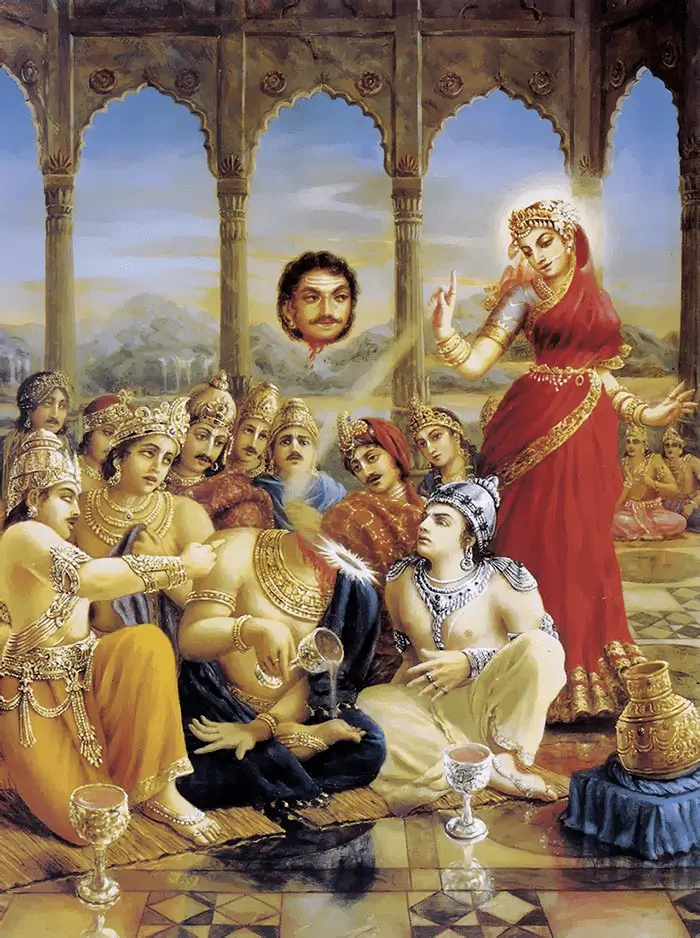
However, one clever Asura named Swarbhanu noticed this deception. He disguised himself as a Deva and sat among them to receive the nectar. Lord Vishnu did not recognize him at first, and he successfully drank a few drops of Amrit.
The Punishment of Swarbhanu
As Swarbhanu consumed the nectar, Surya (the Sun God) and Chandra (the Moon God) realized his trick. They immediately informed Lord Vishnu, who became furious. In his anger, Vishnu took his Sudarshan Chakra and beheaded Swarbhanu before the nectar could spread through his entire body.
Since Swarbhanu had already consumed the Amrit, he did not die. Instead, his head became immortal and was called Rahu, while his body became Ketu. Lord Brahma gave them a place in the navagrahas (nine planets), and they became shadow planets that influence human lives.
The Origin of the Solar Eclipse
Even though Rahu had become immortal, he was filled with anger and hatred towards the Sun and the Moon for exposing his trick. As revenge, he constantly chases them across the sky.
- When Rahu catches the Sun, he swallows it, causing a solar eclipse.
- When he catches the Moon, it results in a lunar eclipse.
However, since Rahu is only a head without a body, the Sun and Moon eventually escape through his neck, making the eclipse temporary. This cycle of chasing, swallowing, and releasing continues, explaining the Hindu mythological reason for eclipses.
Spiritual and Religious Significance of Solar Eclipses
In Hindu culture, solar eclipses are considered inauspicious because they are believed to be a time of negative energy due to Rahu’s influence. Many spiritual practices are followed during this time.
- Fasting and Avoiding Food
People avoid eating during an eclipse as food is believed to absorb negative energy.
- Chanting Mantras
Sacred mantras like the Maha Mrityunjaya Mantra and Vishnu Mantra are chanted for protection.
- Bathing for Purification
It is believed that taking a bath before and after the eclipse helps remove any negative effects.
- Avoiding Important Activities
People avoid starting new tasks, traveling, or making important decisions during an eclipse.
- Temple Rituals and Donations
Many temples close their doors during an eclipse and reopen after purification rituals. People also donate food and clothes to reduce the impact of Rahu’s negative energy.
The Hindu mythological story of Rahu, Ketu, and the solar eclipse is a fascinating tale that explains the eclipse through a blend of cosmic justice, karma, and divine intervention. While modern science sees eclipses as natural astronomical events, Hindu tradition considers them spiritually significant moments. The tale of the solar eclipse is not just about astronomy. It is also about mythology, faith, and cultural heritage, reminding us of the eternal cosmic balance between good and evil. Connect for More!

Leave A Comment