
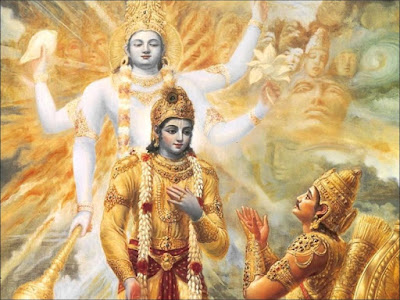
The Immortality of the Soul: Bhagavad Gita’s Divine Perspective
The Bhagavad Gita, one of the most sacred scriptures of Hinduism, is a conversation between Lord Krishna and the warrior Arjuna on the battlefield of Kurukshetra. It addresses deep philosophical and spiritual questions, including the nature of life, death, and the soul. One of the key teachings of the Bhagavad Gita is the immortality of the soul, which means that the soul never dies but simply moves from one body to another.
The Eternal Nature of the Soul
According to the Bhagavad Gita, the soul (Atman) is eternal and indestructible. In Chapter 2, Verse 20, Lord Krishna tells Arjuna,
“For the soul, there is neither birth nor death at any time. It has not come into being, does not come into being, and will not come into being. The soul is unborn, eternal, ever-existing, and primeval. It is not slain when the body is slain.”
This verse clearly explains that the soul is beyond birth and death. While the physical body is temporary, the soul continues to exist even after the body perishes.
The Soul and Reincarnation
The Bhagavad Gita introduces the concept of reincarnation, which means that the soul leaves one body and enters another. In Chapter 2, Verse 22, Krishna uses a simple analogy to explain this,
“Just as a person discards old clothes and wears new ones, so does the soul discard old bodies and take on new ones.”
This means that death is not the end but simply a transition. The soul takes birth in different bodies based on its past actions (karma).
Freedom from Fear of Death
One of the reasons Krishna explains the immortality of the soul is to remove Arjuna’s fear of death. Arjuna is reluctant to fight in the war because he does not want to kill his relatives and teachers. Krishna reminds him that he is only destroying their bodies, not their souls. Since the soul is eternal, death is just a change of form and should not be feared.
Liberation from the Cycle of Birth and Death
The Bhagavad Gita teaches that while the soul keeps taking birth repeatedly due to karma, it can attain moksha (liberation) by realizing its divine nature. Those who attain self-realization do not take birth again but merge with the Supreme Being.
Krishna tells Arjuna in Chapter 4, Verse 9,
“One who understands the divine nature of My birth and activities does not take birth again after leaving the body but attains My eternal abode.”
This means that those who dedicate themselves to selfless devotion and knowledge can free themselves from the cycle of life and death.
The Bhagavad Gita teaches that the soul is immortal, while the body is temporary. Death is not the end but a passage to another life. Understanding this truth helps individuals overcome fear, accept life’s challenges, and focus on spiritual growth. By following the teachings of the Gita, one can move towards liberation and eternal peace. The Bhagavad Gita provides a profound message of hope and courage, reminding us that our true self is beyond birth and death, and we are all part of the eternal cosmic existence. View More Posts!

Thank you for your sharing. I am worried that I lack creative ideas. It is your article that makes me full of hope. Thank you. But, I have a question, can you help me?