
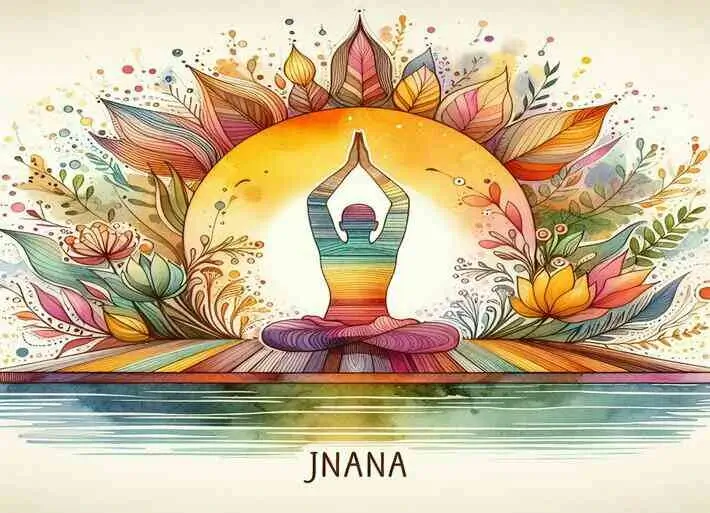
Jnana Yoga is one of the four main paths to spiritual freedom in Hinduism, especially explained in the Bhagavad Gita. It is the path of knowledge. It’s not just book knowledge but a deep wisdom of understanding who we truly are.
What is Jnana Yoga?
Jnana means knowledge in Sanskrit. In Jnana Yoga, the goal is to realise the truth of our inner Self (Atman) and to understand that this Self is not separate from the Supreme Reality, which is called Brahman. It teaches that we are not the body, not the mind, but the eternal soul, unchanging, pure, and free. Once we realise this, we become free from fear, sorrow, and attachment.
Key Teachings of Jnana Yoga in the Gita
Atman is Eternal
In Chapter 2, Krishna tells Arjuna:
“The soul is never born, nor does it ever die… It is eternal and beyond time.”
This means we are not this body, which dies, but the eternal Atman that lives on.
Real vs Unreal
Jnana Yoga helps us understand the difference between the temporary and the eternal. The body, emotions, and thoughts change but the Self is constant.
Detachment from the World
A wise person sees pleasure and pain, success and failure as equal. This is not coldness; it’s inner peace from knowing the world is ever-changing.
Self-Inquiry (Who am I?)
The seeker asks, “Who am I really? Am I just this body, or something deeper?” This questioning leads to true wisdom.
Unity of Atman and Brahman
The highest realization is,
“I am not separate from God. My soul and the Supreme Soul are one.”
This is called non-duality (Advaita).
Who Can Follow Jnana Yoga?
Jnana Yoga is usually for people who,
- Love to question and think deeply
- Are calm and focused
- Want truth over comfort
- Can be inwardly detached
But anyone can follow it, even alongside Bhakti (devotion) or Karma (selfless action).
How to Practice Jnana Yoga
- Shravana (Listening) – Read or listen to spiritual teachings from the Gita, Upanishads, or wise teachers.
- Manana (Reflection) – Think deeply about what you’ve heard. Does it feel true? Can you apply it in life?
- Nididhyasana (Meditation) – Meditate on your true nature. Sit quietly and ask, “Who am I?”
Result of Jnana Yoga
A Jnani (wise person),
- Is peaceful and fearless
- Sees all beings as equal
- Lives without attachment
- Knows the Self and is free (liberated)
This freedom is called moksha, the final goal of life.
Final Thought
Jnana Yoga teaches that you are already free; you just have to realise it. Through deep thought, inner silence, and self-inquiry, you can discover the light that has always been within you.
As Krishna says in the Gita,
“There is nothing more purifying than knowledge. In time, the soul who is perfected in yoga finds it within.” (Gita, 4.38) – Connect for more!

Leave A Comment