
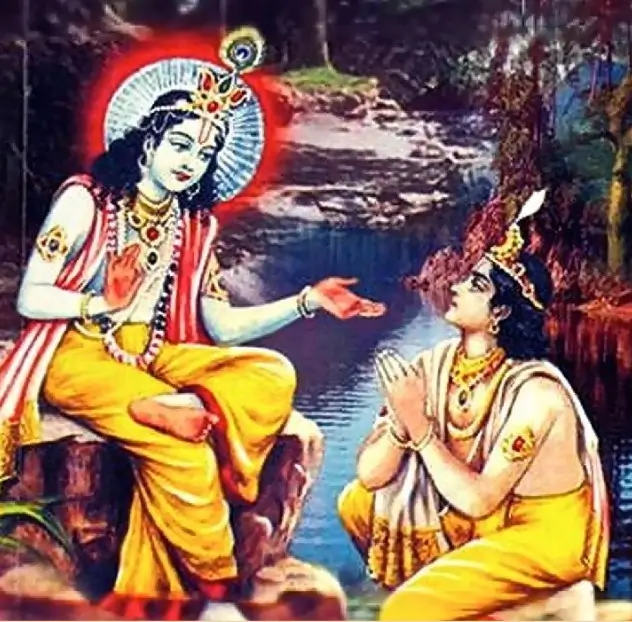
Uddhava Gita: The Spiritual Teachings of Lord Krishna
The Uddhava Gita is an important part of the Shrimad Bhagavatam (also called Bhagavata Purana). It consists of Lord Krishna’s final teachings to his close devotee, Uddhava, before leaving the earthly world. These teachings are similar to the Bhagavad Gita but are more detailed and philosophical.
In the Bhagavad Gita, Krishna teaches Arjuna about duty, devotion, and self-realization in the middle of a battlefield. In contrast, the Uddhava Gita takes place in a peaceful setting, where Krishna shares deep spiritual wisdom with Uddhava to prepare him for the difficult times ahead.
Background of the Uddhava Gita
At the end of Lord Krishna’s earthly life, he realizes that his divine mission is complete. The Yadava dynasty, to which Krishna belongs, is destined to be destroyed. Krishna is ready to leave the world and return to his eternal abode, Vaikuntha.
Uddhava, Krishna’s close friend and devotee, becomes sad upon hearing this. He does not want to live in a world without Krishna. He asks Krishna for guidance on how to live in his absence. In response, Krishna shares deep spiritual wisdom, which becomes known as the Uddhava Gita.
Main Teachings of the Uddhava Gita
The Uddhava Gita contains many important lessons about life, devotion, and liberation.
- The Temporary Nature of the World
Krishna explains that everything in this world, including the body, wealth, relationships, and possessions, is temporary. Just as seasons change, life is constantly changing. A wise person does not become too attached to material things.
- Detachment and Devotion
Krishna tells Uddhava that the best way to live is through detachment (Vairagya) and devotion (Bhakti). True devotion means surrendering completely to God, without expecting anything in return. A person who is devoted to God does not suffer from sorrow or fear.
- The Importance of Self-Realization
The ultimate goal of life is to realize the true nature of the self (Atman). Krishna teaches that the soul is different from the body and mind. The soul is eternal and connected to God. A person who understands this does not get disturbed by happiness or sorrow.
- The Path of a Wise Person (Sthitaprajna)
A wise person (Sthitaprajna) remains calm in all situations. He does not get overly excited when things go well or depressed when things go wrong. Such a person is always focused on God and does not get distracted by worldly pleasures.
- The Story of the Avadhuta (Renunciate)
Krishna tells Uddhava the story of Avadhuta, a wandering saint, who had 24 natural gurus. These gurus included the earth, water, fire, wind, the sun, and even simple creatures like birds and insects. From each of them, he learned valuable life lessons, such as patience, simplicity, and selflessness.
- The Three Paths to Liberation
Krishna describes three main paths to liberation (Moksha).
- Bhakti Yoga (Path of Devotion) – Loving and worshipping God with a pure heart.
- Jnana Yoga (Path of Knowledge) – Understanding the true nature of reality.
- Karma Yoga (Path of Action) – Performing one’s duties without selfish motives.
Although all three paths lead to liberation, Krishna emphasizes that Bhakti Yoga (devotion) is the easiest and most effective path.
- Life After Krishna’s Departure
Krishna advises Uddhava to leave the materialistic world and go to the Himalayas to meditate. By focusing on God, Uddhava can attain liberation and be free from sorrow. Uddhava follows Krishna’s advice and lives the rest of his life in spiritual contemplation.
Significance of the Uddhava Gita
The Uddhava Gita is considered a masterpiece of Hindu philosophy. It explains many deep concepts in a simple and practical way. While the Bhagavad Gita is focused on performing one’s duty in the world, the Uddhava Gita is more about renunciation and spiritual wisdom. Many saints and scholars have praised the Uddhava Gita for its timeless wisdom. It teaches us how to live with peace, wisdom, and devotion, even in difficult times.
The Uddhava Gita is Krishna’s final message to humanity. It teaches that life is temporary, and true happiness comes from devotion to God. By following Krishna’s teachings, one can live a life of peace, wisdom, and spiritual fulfillment. The lessons of the Uddhava Gita remain relevant even today, guiding us towards a meaningful and enlightened life. Connect for More!

I don’t think the title of your article matches the content lol. Just kidding, mainly because I had some doubts after reading the article.